
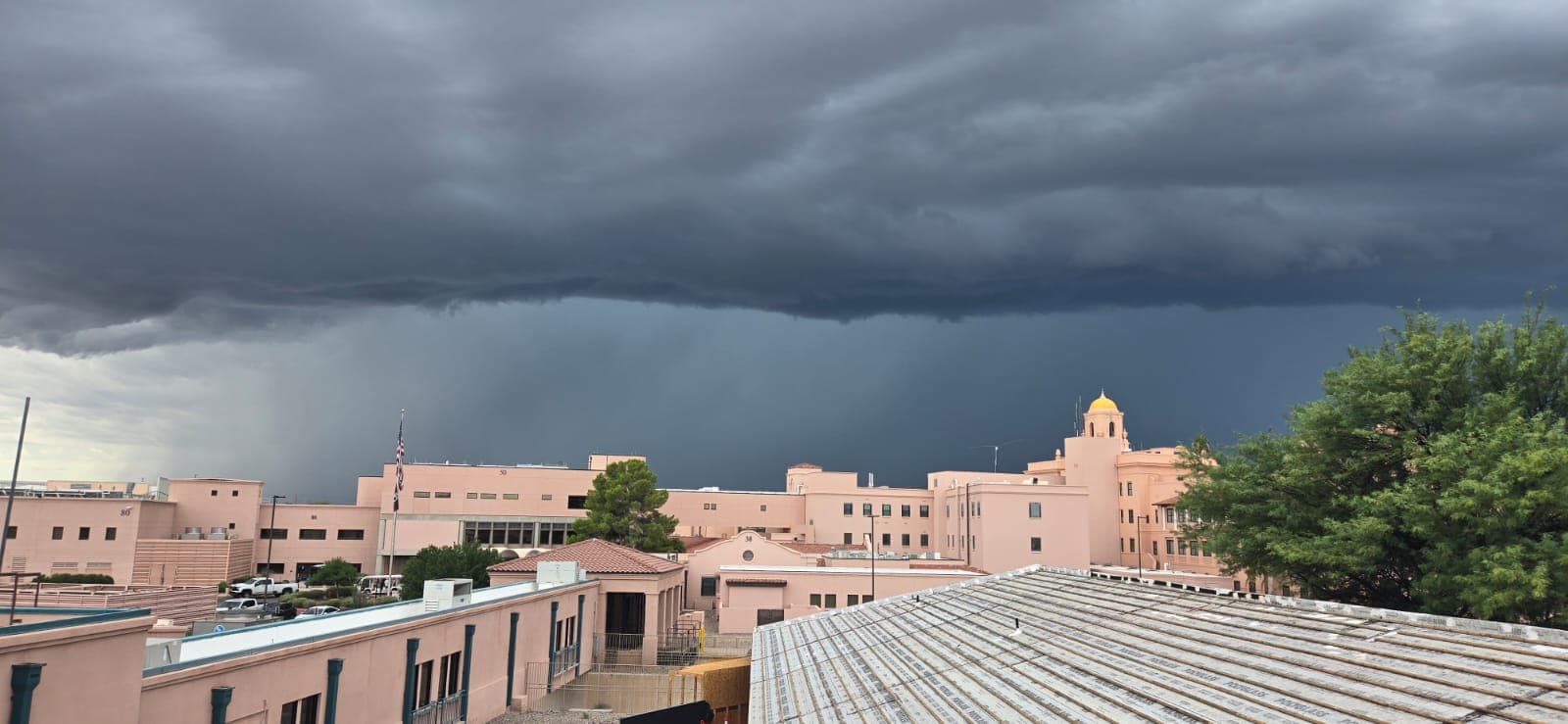
Services/Storm & monsoon repair
Storm & Monsoon Damage Repair across the Tucson metro.
Storm and monsoon roof damage repair across Tucson and Southern Arizona. Active leak? We tarp it the same day. Need an assessment for insurance? Drone-documented within 48 hours. Pre-monsoon prep so the storms don't catch you off guard, post-storm cleanup so the next one doesn't make it worse.
- Free estimate within 24 hours
- Family-owned · Tucson · Since 2014
- 1,000+ roofs across Pima & Cochise County
- Drone-inspected — start to finish
- Federal: Fort Huachuca · Sierra Vista AFB · Tucson VA
In short
Storm damage roof repair in the Tucson metro covers monsoon and hail damage assessment, emergency tarp service, and the repair work that follows — most often after July through September monsoon storms. Common Tucson storm damage includes wind-lifted tiles, microburst-displaced flashing, hail bruising on shingles, and debris impact from cottonwoods and palo verdes. We document with drone footage for insurance claims, work directly with adjusters, and complete most spot repairs in 1–3 days once materials are on hand.
- Lifespan
- Spot repair 5–15 years · Re-roof if widespread
- Typical job
- Tarp same-day · Repair 1–3 days · Insurance work 2–4 weeks
- Best fit for
- Active leaks, post-monsoon damage, hail, pre-monsoon prep
Plain English
Storm damage repair, in plain English.
Tucson monsoons hit hard and fast — driving rain, microbursts, and hail can break tiles, lift flashing, and force water through underlayment that was already weakening. Storm damage repair covers the full range: emergency response (tarping a leak, sealing a hole), assessment and documentation for insurance, and the actual repairs. We also do pre-monsoon prep — checking flashing, clearing debris, and replacing underlayment that won't survive another season.
Local conditions
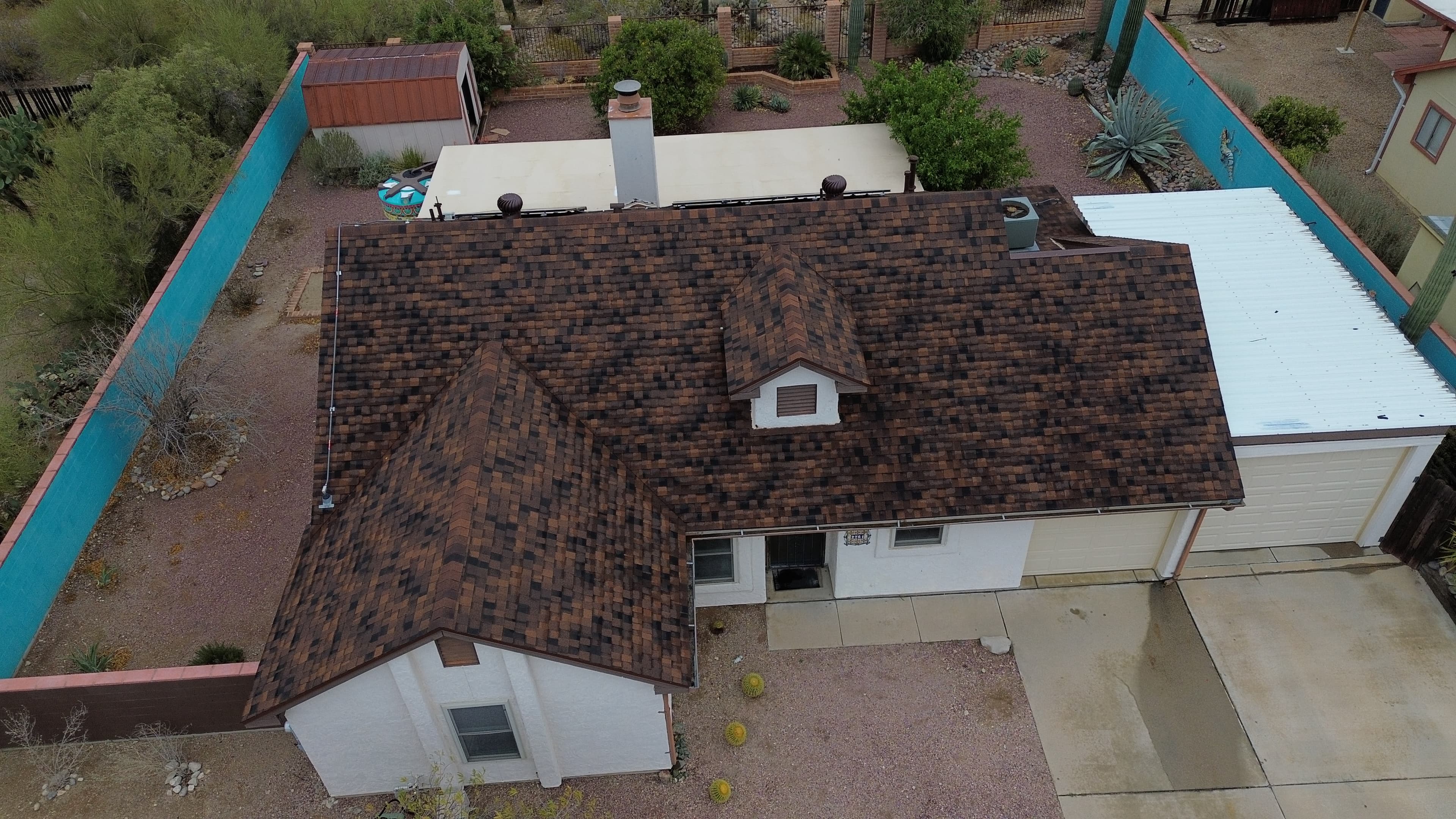
How Tucson monsoon shapes the work.
Three things from the field —
- I
Monsoon timing matters.
Tucson's monsoon hits hardest July through early September with microbursts, wind-driven rain, and occasional hail. Damage is concentrated in those eight weeks. We respond fastest when we know the storm pattern in advance and have crews staged for it.
- II
Storm damage vs wear matters for insurance.
Adjusters distinguish between sudden storm damage (covered) and gradual wear (not covered). The distinction matters in the documentation. Wind-lifted tiles after a microburst is storm damage; granule loss accumulating over a decade is wear. We document both clearly so the claim goes through cleanly.
- III
East side and SE corner take more hail.
Vail, Tanque Verde, and Corona de Tucson see harder hail than central or west Tucson because storm cells funnel through the Rincon corridor. Hail-related shingle damage is most common in those areas. Class 4 impact shingle on re-roofs in those zones reduces future claims meaningfully.
Signs to call
When a storm call is the right call.
- 01Active leak during or after a monsoon — water dripping inside, ceiling stains spreading.
- 02Visible damage after a storm — missing tiles, lifted shingles, loose flashing, downed branches on the roof.
- 03Hail strike during a microburst — bruising, granule loss, or dented metal accessories.
- 04Filing an insurance claim and need documented evidence the damage came from the storm.
- 05It's May or early June and you want pre-monsoon prep before the season hits.
- 06Post-monsoon cleanup — even without obvious damage, debris can hide problems that surface in the next storm.
Our approach
How storm-damage work goes.
Step-by-step from inspection to walkthrough — the approach we follow on every job.
- 01
Emergency tarp within 24 hours for active leaks — we secure the affected area so water stops getting in while you sort out the longer fix.
- 02
Drone inspection to document the damage from above — useful for insurance claims and avoids walking on tiles that may already be cracked.
- 03
Written assessment with stills, video, and a clear breakdown of what was caused by the storm vs. what was pre-existing wear. Insurance adjusters care about this distinction.
- 04
Repair scope and quote — straight, no upselling. Sometimes it's a few cracked tiles and a flashing replacement. Sometimes the storm exposed a roof that was already failing and a re-roof makes more sense. We tell you which.
- 05
Coordination with insurance — we work directly with adjusters, send documentation, and answer their questions. You don't have to be the middleman.
The spec
What we use and what shapes the price.
Timeline —Emergency tarp: same-day or next-day, weather permitting. Inspection and written assessment: 48 hours. Most spot repairs (cracked tiles, flashing, small underlayment patches): 1–3 days once materials are on hand. Insurance-claim work runs on the adjuster's timeline — usually 2–4 weeks from filing to start.
What affects the cost —
- 01
Repair scope — a few cracked tiles vs. a full slope or full re-roof.
- 02
Insurance involvement — adjuster timelines and documentation requirements add days, not always cost.
- 03
Tarp duration — emergency tarps are short-term; long emergency cover adds material cost.
- 04
Hidden damage — sometimes the storm exposes underlayment failure that was already coming, and a re-roof is the better economic call.
Storm-repair shortcuts that hurt you later — what we won't do.
Pushing full re-roof when spot repair works.
Some contractors will quote a full re-roof for any storm-damaged roof to maximize the insurance payout. Often the right answer is a spot repair — replace the cracked tiles, reset the lifted flashing, document — and you're done for another decade. We tell you when full re-roof is overspec.
Inadequate insurance documentation.
Insurance claims fail when documentation is thin. Some contractors hand over a few photos and call it good; adjusters need stills, video, written notes from a licensed contractor, and clear evidence the damage came from a specific event. We document to that standard.
Tarping without securing properly.
A bad tarp lasts a day, then peels off in the next gust and exposes the roof again. Proper tarping uses 6-mil reinforced tarps with sandbags and screw-down attachments where appropriate. Cheap tarping makes things worse.
Waiting too long after a storm.
Storm-damaged roofs are vulnerable to interior damage from the next rain. Waiting weeks for an inspection means small leaks become major water damage. We respond same-day or next-day for active leaks; assessment within 48 hours otherwise.
Storm damage, common questions.
The questions we hear most before homeowners sign — pricing, timing, materials, warranty.
01Do you do emergency tarping during a monsoon?
Yes — same-day or next-day for active leaks, weather permitting. We don't fly tarps in driving rain or high wind, but as soon as the storm cell passes, we're up there. The goal is to stop water intrusion while you and the insurance company sort out the longer fix.
02How do I know if the damage is from the storm or just normal wear?
It matters for insurance — adjusters distinguish between sudden storm damage and gradual wear. Storm damage usually has clear physical evidence: a specific tile broken at impact, flashing torn loose at one corner, hail bruising in a pattern. Wear-related failure looks different: granule loss spread evenly, underlayment cracking from age, slow leak stains. Our drone footage and written assessment lay out which is which, with photos.
03Can you handle the insurance claim for me?
We can't file the claim on your behalf — that has to come from the homeowner — but once it's filed, we work directly with your adjuster. We provide all documentation, answer their questions, and meet them on site when needed. Most claims we work go through cleanly because the documentation is thorough up front.
04Should I do pre-monsoon prep every year?
Worth it on tile and flat roofs older than 10 years, and on any roof with known weak points (older flashing, marginal underlayment, large ponding spots). May through early June is the right window. We check flashing, clear debris, look for cracked tiles, and flag anything that probably won't survive another monsoon season.
05How fast can you respond to a Tucson storm-damaged roof?
Same-day or next-day for active leaks, weather permitting. We don't fly tarps in driving rain or high wind, but as soon as the storm cell passes we're up there. Documented assessment within 48 hours otherwise. We monitor monsoon forecasts and stage crews for the storm season.
06What's the difference between hail damage on tile vs shingle?
On tile, hail typically bruises or fractures concrete tile or chips clay tile — visible from drone but not always from the ground. On shingle, hail bruises the granule layer and accelerates wear; sometimes visible immediately, sometimes only over months as bald spots develop. Insurance handles both, but documentation differs.
07Should I get a roof inspection if I think there's storm damage but no leaks yet?
Yes. Storm damage often shows up as leaks weeks or months after the event — water finds the path of least resistance. Drone inspection within a week of any major storm catches the damage before it becomes interior water damage. Free as part of any quoted work, flat-rate standalone if you just want documentation.
08Will my Tucson homeowners insurance cover monsoon damage?
Usually yes for sudden storm damage — wind-lifted tiles, hail bruising, debris impact. Insurance won't cover gradual wear (failed underlayment from age, granule loss from years of UV). The distinction matters for the claim. Our drone footage and written assessment lay out which is which, with photos and notes adjusters accept. State Farm, Allstate, Farmers, and most major Arizona insurers accept our documentation routinely.
Where we work
Storm & monsoon repair across the metro.
Pima County metro — click a city for area-specific work patterns, HOA standards, and recent jobs.
Reviewed by —Efren CoronadoOwner & lead estimator, Coronado Roofing. Tucson roofer since 2014. Storm damage work spans tile, shingle, and flat-roof systems across Pima County, with extensive insurance-claim documentation and emergency tarp deployment during monsoon season. FAA Part 107 drone-certified.
Last updated —
Other services
Other roofing services.
Same crew, same drone-first inspection, same materials — across every kind of roof we work.
Ready for a real quote?
Drone inspection. Honest assessment. No pressure.
Mon–Fri · 7am–5pm·Saturday by appointment