
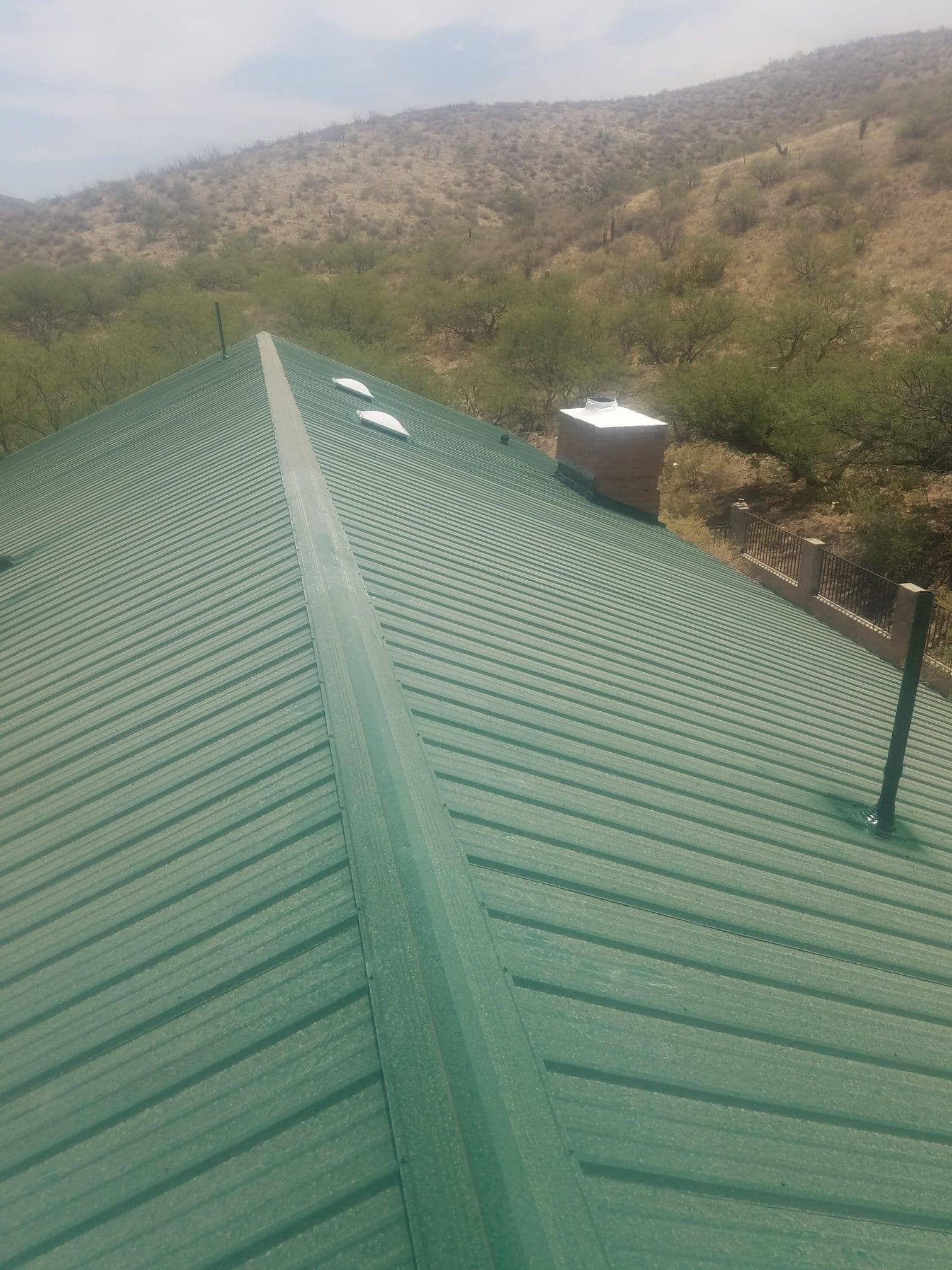
Services/Metal roofing
Metal Roofing across the Tucson metro.
Standing-seam metal roofing for Tucson homes and commercial buildings — coated-steel panels with premium fluoropolymer finishes, installed with hidden-clip fastening that handles Sonoran daily temperature swings and monsoon wind. Drone-inspected, family-owned since 2014.
- Free estimate within 24 hours
- Family-owned · Tucson · Since 2014
- 1,000+ roofs across Pima & Cochise County
- Drone-inspected — start to finish
- Federal: Fort Huachuca · Sierra Vista AFB · Tucson VA
In short
Metal roofing in the Tucson metro is most often standing-seam coated-steel panels with a premium fluoropolymer finish paint finish, installed with hidden clips that allow the panels to expand and contract through Tucson's daily 100°F+ surface-temp swing. We do metal on contemporary customs (especially in the Catalina Foothills and Oro Valley), accent roofs on otherwise-tile homes, low-slope sections, and federal commercial buildings. Lifespan in Tucson sun runs 40–50 years when installed correctly — longer than tile or shingle, at a higher upfront cost.
- Lifespan
- 40–50 years in Tucson sun
- Typical job
- 5–10 working days for residential install
- Best fit for
- Contemporary customs, accent slopes, low-slope sections, federal/commercial
Plain English
Standing-seam metal, in plain English.
A metal roof system uses interlocking standing-seam panels (typically 24-gauge coated-steel panels with a fluoropolymer paint finish) fastened to the deck with hidden clips that allow the metal to expand and contract with temperature changes. In Tucson, where roof surface temperatures swing from 40°F at dawn to 160°F+ at midday in summer, the right fastening method matters more than almost anywhere else. Standing-seam metal lasts 40–50 years here when installed correctly — longer than tile or shingle, with a higher upfront cost and a distinctly modern look.
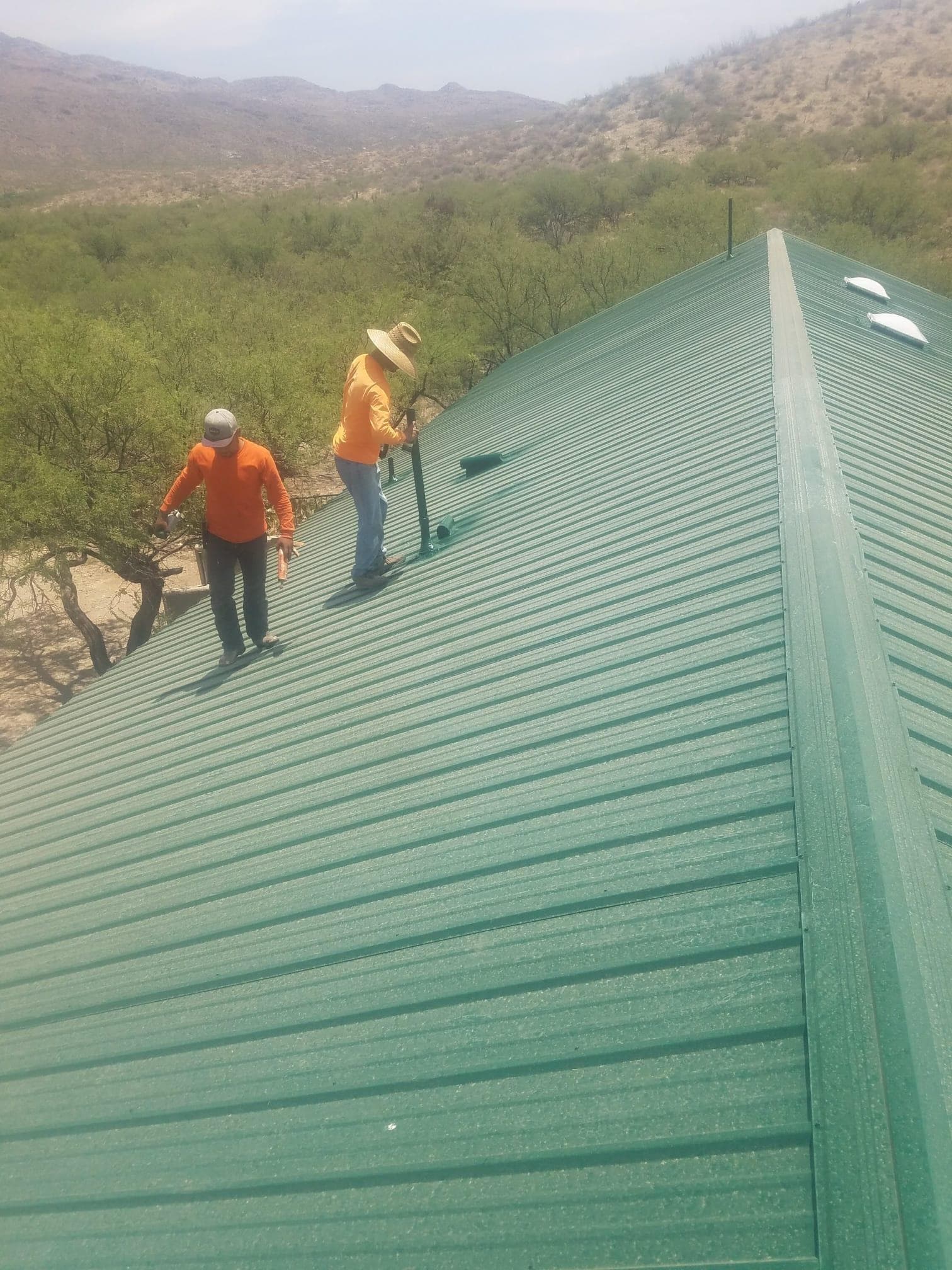
Local conditions
What Tucson does to metal roofs.
Three things from the field —
- I
Tucson surface-temp swings are extreme.
On a darker metal roof in Tucson summer, surface temps hit 160°F at midday and drop to 80°F overnight — the steel expands and contracts inches across a 30-foot run every day. Hidden-clip fastening that allows this movement is essential. Pinned-down panels oil-can (visible buckling) within a year and lose their warranty.
- II
Monsoon wind is the install test.
Standing-seam metal handles wind better than almost any other system when properly fastened — but a single weak transition or insufficient fastening density turns into uplift damage during August microbursts. Continuous fastening at proper spacing and reinforced edge metal is the spec we install to.
- III
Reflective metal drops AC bills measurably.
Light-colored fluoropolymer finishes on metal can reflect 60–70% of solar radiation versus 10–25% for darker tile or shingle. Most homeowners see meaningful summer cooling cost savings, especially on larger flat or low-slope metal roofs.
Signs to call
When metal is the right call.
- 01You're building a contemporary or modern custom and want a metal-aesthetic roof.
- 02Replacing aged metal accents (chimneys, dormers, low-slope sections) on a tile or shingle home.
- 03A flat-roof addition or accessory structure that needs better water-shedding than a coating.
- 04Commercial building where TPO or modified bitumen isn't the right fit.
- 05You want the longest-lifespan residential roof system Tucson supports.
Our approach
How a metal install goes.
Step-by-step from inspection to walkthrough — the approach we follow on every job.
- 01
Drone inspection and design review — metal has different drainage, flashing, and ventilation requirements than tile or shingle. We measure twice before we order.
- 02
Panels custom-cut to length on site for runs without horizontal seams. No off-the-shelf 'cut to fit on the roof' approach.
- 03
Hidden-clip fastening that allows thermal movement. Tucson's surface-temp swing requires this — pinned-down panels oil-can within a year.
- 04
Continuous high-temp underlayment beneath the panels (high-temp underlayment or equivalent) so any incidental moisture has somewhere to go.
- 05
Final walkthrough with manufacturer warranty registration. Most reputable systems carry 30–40 year material warranties when installed to spec.
The spec
Panel systems and what shapes the price.
Timeline —Most residential metal re-roofs run 5–10 working days from tear-off to walkthrough. Commercial standing-seam can run 2–4 weeks depending on size and access. Lead time for panel manufacturing is typically 2–4 weeks — we bake that into the calendar.
What affects the cost —
- 01
Panel gauge — 24-gauge is residential standard; 22-gauge for commercial or high-wind exposure.
- 02
Finish grade — premium fluoropolymer finish vs lower-grade SMP vs basic galvanized; affects warranty and longevity.
- 03
Trim and flashing complexity — penetrations, valleys, and transitions on a metal roof are pricier than tile because they need custom fabrication.
- 04
Slope and access — steeper or harder-to-access roofs add labor.
Metal install shortcuts that fail in Tucson sun — what we don't do.
Pinned-down panels.
Some installers fasten panels through the seam directly into the deck — fast and cheap, but it locks the panel against thermal expansion. In Tucson surface-temp swings, the panels oil-can within a year and the manufacturer warranty voids. We use hidden-clip fastening every time.
Cheap exposed-fastener systems on visible slopes.
Exposed-fastener metal (the screws-through-the-panel kind) is fine for outbuildings, agricultural structures, and back-of-house slopes. On a visible slope of a residential home, exposed fasteners back out, leak, and look industrial within a few years. Standing-seam is the right call for visible slopes.
Skipping the high-temp underlayment.
Metal traps heat against the underlayment — surface temps under panels routinely hit 180°F. Standard 30-lb felt or basic synthetic underlayment fails fast under that thermal load. We install high-temp underlayment or equivalent high-temp self-adhered membrane every time.
Mismatched finishes on accent metal.
When metal is used as accents (chimneys, dormers, accent slopes) on otherwise-tile or shingle homes, the finish should match across the home. We've seen jobs where the chimney metal is a different color or sheen than the dormer metal — looks unfinished. We coordinate finishes across all metal elements.
Metal roofing, common questions.
The questions we hear most before homeowners sign — pricing, timing, materials, warranty.
01How long does a metal roof last in Tucson?
Standing-seam coated-steel panels with a premium fluoropolymer finish typically lasts 40–50 years in Tucson sun when installed correctly. The panels themselves often last longer than the building they're on. Cheaper exposed-fastener systems with lower-grade finishes can fail at 20–25 years here because of UV-degraded paint and backing-out fasteners.
02Is metal roofing more expensive than tile or shingle in Tucson?
Yes — meaningfully more expensive up front. A standing-seam metal re-roof typically runs 50–100% more than equivalent shingle and 20–40% more than concrete tile, depending on panel gauge, finish, and trim complexity. The lifecycle math works out over 30+ years (longer life, lower maintenance, AC savings), but the upfront investment is higher.
03Will a metal roof make my house louder during monsoon storms?
Less than people expect. Modern standing-seam systems with proper underlayment and attic insulation are within a few decibels of tile or shingle during rain. The 'tin barn' sound effect comes from cheap corrugated metal directly over an open framework — that's not what we install on residential homes.
04Can metal roofing be installed over my existing tile or shingle?
Almost never. Tile installations have the wrong substrate (battens, mortar) for metal. Shingle layovers add weight, trap moisture, and void manufacturer warranties on the new metal. We always tear off the existing roof down to the deck before installing metal. The cost difference vs layover is modest; the install quality difference is significant.
05Will metal roofing make my Tucson home cooler?
Yes, measurably — especially with light-colored fluoropolymer finishes. Reflective metal can drop attic temps by 15–25°F during peak summer compared to dark tile or aged shingle. Most homeowners see meaningful summer cooling cost savings, especially on larger or simpler-shaped roofs where the metal area is a high share of total roof surface.
06What about lightning — is a metal roof more dangerous?
No. Metal roofs don't attract lightning, and if struck they actually disperse the charge more safely than wood or shingle (which can ignite). Most modern home insurance treats metal roofing favorably, and we use fully grounded installations on any metal job.
07Is metal roofing right for my Tucson home, or should I stick with tile?
Depends on the architecture and your goals. Metal fits contemporary, modern, and minimalist designs naturally. Tile fits Spanish, Mediterranean, and traditional Sonoran architecture better. For accent roofs (over a patio, on a low-slope section, on a chimney) metal makes sense regardless of the main roof. We assess fit during the inspection.
Where we work
Metal roofing across the metro.
Pima County metro — click a city for area-specific work patterns, HOA standards, and recent jobs.
Reviewed by —Efren CoronadoOwner & lead estimator, Coronado Roofing. Tucson roofer since 2014. Metal roofing work focused on contemporary customs in the Catalina Foothills and Oro Valley, plus federal commercial standing-seam at Fort Huachuca and Sierra Vista AFB. FAA Part 107 drone-certified.
Last updated —
Other services
Other roofing we do.
Same crew, same drone-first inspection, same materials — across every kind of roof we work.
Ready for a real quote?
Drone inspection. Honest assessment. No pressure.
Mon–Fri · 7am–5pm·Saturday by appointment